Picking between SS304 and SS316 stainless steel for CNC machining isn't always straightforward. Both are austenitic grades, offering solid strength and corrosion resistance, but their chemistry and performance in tough environments set them apart.
SS316 contains molybdenum, giving it superior corrosion resistance in salty or chemical-heavy settings. SS304 is more budget-friendly for general jobs and is usually easier to machine.
If your parts are headed for saltwater, chemicals, or acidic conditions, SS316 is the safer bet. For indoor or less demanding uses where cost is a concern, SS304 usually does the trick.
Key Takeaways
- SS316 is pricier, about 1.5 times more than SS304, but handles corrosion much better thanks to molybdenum.
- SS304 is easier to machine and suits indoor or general applications where extreme corrosion resistance isn't a must-have.
- Pick your grade based on the environment, budget, and what you really need from your CNC project.
Quick Overview of SS304 vs SS316 for CNC Machining
The choice between 304 and 316 stainless steel can shape your project's cost and durability. Both are strong, but their chemistry makes one better for certain CNC machining uses than the other.
Understanding the Purpose of Material Selection
When choosing materials for CNC machining, you've got to match the stainless steel grade to your needs. The wrong pick could mean early failure or wasted money.
SS304 is a go-to for general jobs. It's got 18% chromium and 8% nickel, making it a solid pick for indoor gear or food industry equipment.
SS316, on the other hand, brings molybdenum to the table, about 2-3%, which boosts its resistance to salt and chemicals. If you're dealing with tough environments, this is the one to look at.
Of course, price matters too. SS316 costs more, so you really want to be sure you need that extra performance.
Key Distinguishing Properties for CNC Projects
Here's what you should look at when deciding between these grades for your CNC parts:
Corrosion Resistance: SS316 wins in harsh, salty, or chemical-heavy environments. That molybdenum really pays off here.
Machinability: 304 is easier to machine. SS316 wears out tools faster and needs more careful handling.
Strength: They're close in tensile strength, but SS316 holds up a bit better at higher temps.
Cost: Expect to pay 20-30% more for SS316. That adds up on bigger runs.
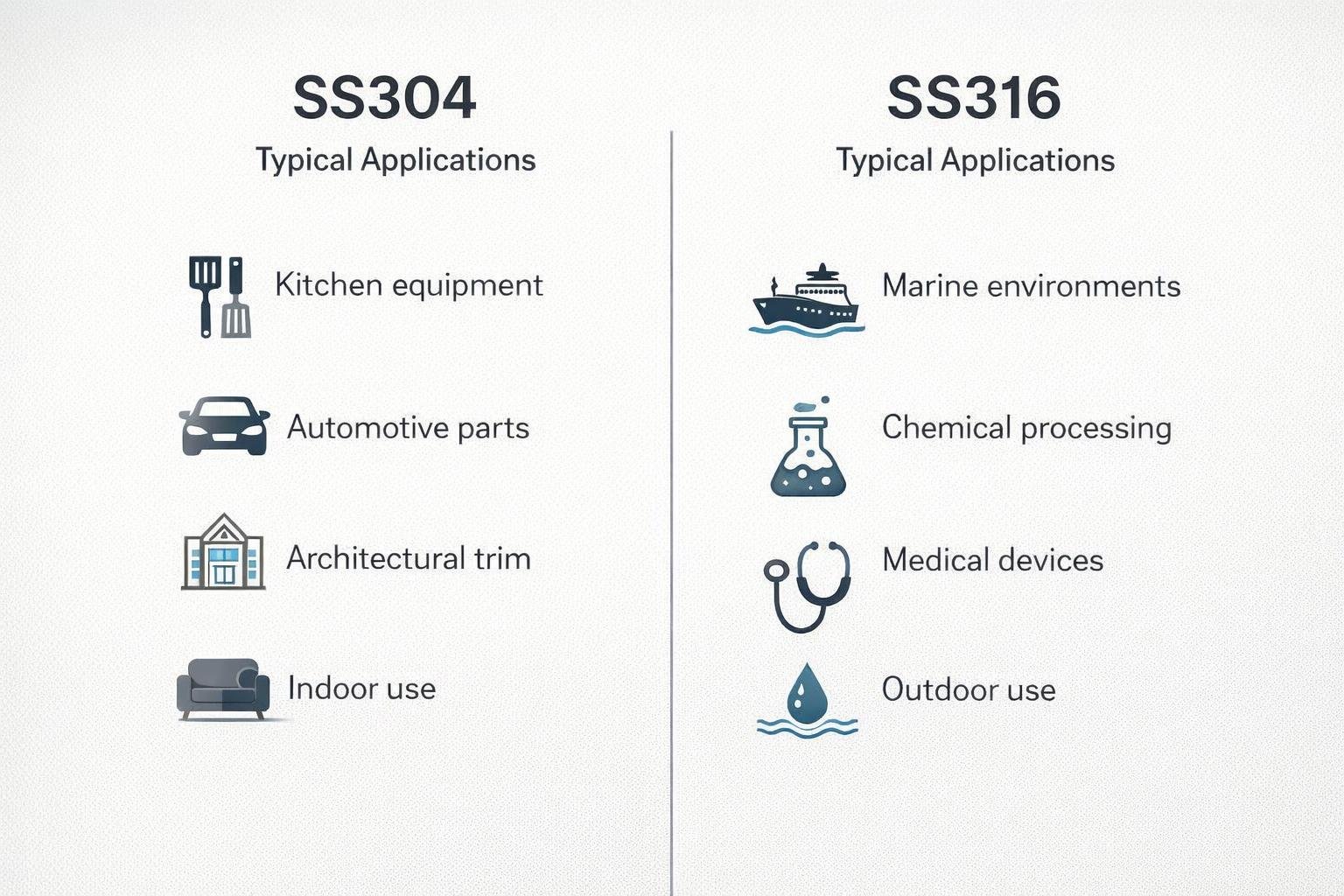
Applications: SS304 is common in kitchen gear and general manufacturing. SS316 is for marine hardware, medical tools, or chemical processing, places where corrosion can't be ignored. More on this at JLC CNC.
Chemical Composition Differences and Their Impact
The real split between SS304 and SS316 is in their alloying elements, especially molybdenum in 316. That tweak changes how they handle corrosion, machining, and even cost.
Chromium, Nickel, and Molybdenum Content
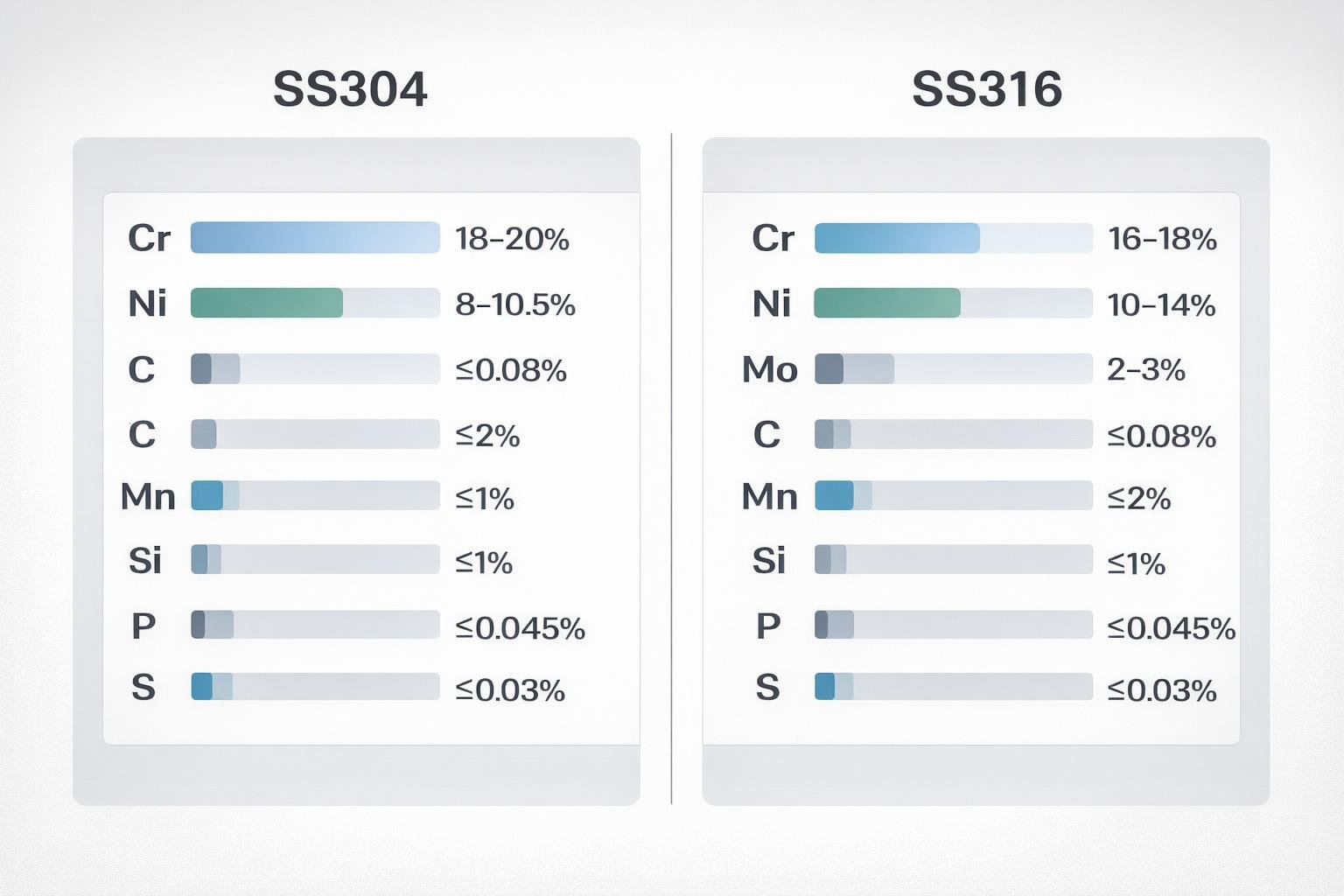
The chemical makeup is what shapes performance. SS304 has 18-20% chromium and 8-10.5% nickel. SS316 is similar but with 10-14% nickel and, crucially, 2-3% molybdenum.
Both have about 0.08% max carbon, under 2% manganese, and less than 1% silicon. Nothing wild there.
| Element | SS304 | SS316 |
|---|---|---|
| Chromium | 18-20% | 16-18% |
| Nickel | 8-10.5% | 10-14% |
| Molybdenum | 0% | 2-3% |
| Carbon | ≤0.08% | ≤0.08% |
| Manganese | ≤2% | ≤2% |
That extra nickel and molybdenum in SS316 make it a bit tougher to machine than SS304. Not a dealbreaker, but you'll notice it.
Role of Molybdenum in 316 Stainless Steel
Molybdenum is the main thing setting SS316 apart. It shields against chlorides and other nasty stuff. If you're making parts for marine or chemical use, that 2-3% molybdenum is what you're paying for.
It does make machining trickier. You'll see more work hardening, so you need sharp tools and steady feeds to keep things cool and avoid headaches.
Molybdenum also bumps up the price. SS316 can be about 75% pricier than SS304, so only go for it if you truly need the extra resistance.
ASTM A240 and International Standards
ASTM A240 is the go-to standard for 304 and 316 stainless steel plates and sheets. It sets the chemical ranges and quality checks you want before machining.
Mills have to document the chemistry for every batch. Always ask for those test reports, better safe than sorry.
There are international equivalents, like EN 10088 for Europe and JIS G4305 for Japan. They're mostly similar, but double-check your supplier's paperwork matches your region's standard.
Mechanical and Physical Properties in CNC Machining
Both grades are strong, but 316 is a little trickier to machine because it hardens faster as you cut. Their thermal properties are close, but not identical, something to keep in mind for tool selection.
Comparison of Strength and Hardness
SS304 and SS316 are pretty evenly matched for strength. SS304's tensile strength is 515-620 MPa; SS316 is 515-655 MPa. Yield strength is about 205 MPa for 304, and 205-290 MPa for 316.
Hardness? SS304 is usually 201 HB on the Brinell scale, SS316 is around 217 HB. Not a huge difference, but 316 does take a bit more force to cut.
Elastic modulus is basically the same at 193 GPa. Both offer about 40% elongation, good ductility for forming if you need it.
| Property | SS304 | SS316 |
|---|---|---|
| Tensile Strength | 515-620 MPa | 515-655 MPa |
| Yield Strength | 205 MPa | 205-290 MPa |
| Hardness (Brinell) | 201 HB | 217 HB |
| Elongation | 40% | 40% |
Work Hardening and Machinability
SS316 work hardens faster than SS304. That molybdenum again, it makes the material tougher as you machine, so your tools have a harder time as you keep cutting.
SS304 is easier on your tooling and lets you run faster. SS316 needs slower speeds and you'll probably swap out tools more often.
With 316, keep your feed rates steady and don't let the tool dwell in one spot. Interrupted cuts are rough on both, but 316 is less forgiving. Expect higher tooling costs with 316 since it wears out bits and inserts quicker.
Thermal and Heat Resistance
The thermal expansion coefficient comes in at 17.2 µm/m°C for SS304 and 15.9 µm/m°C for SS316, measured between 0-100°C. That difference can mess with dimensional stability during machining, especially when things heat up from cutting.
Both grades melt around 1400-1450°C. The thermal conductivity is almost neck-and-neck, 16.2 W/m·K for 304 and 16.3 W/m·K for 316, so don't expect a big difference in heat dissipation during CNC work.
Heat resistance for continuous service is about 870°C for SS304 and 925°C for SS316. You won't need to heat treat either before machining, but stress relieving at 400-450°C can help with dimensional stability if you're chasing tight tolerances.
Corrosion Resistance: SS304 vs SS316 in Demanding Environments
SS316 has 2-3% molybdenum, which really boosts its corrosion resistance compared to SS304, especially around chlorides, acids, or saltwater. This can be a dealbreaker when you're picking material for CNC parts that'll see harsh service.
Pitting and Crevice Corrosion Performance
The PRE, pitting resistance equivalent, number gives you a sense of localized corrosion resistance. SS304 sits at about 18-20, while SS316 jumps to 24-26 thanks to the molybdenum.
SS316 shrugs off pitting and crevice corrosion better than 304, especially where water or gunk can get trapped. Pitting makes nasty little holes that get deeper over time. Crevice corrosion pops up in tight spots or under deposits.
If you're machining parts with tricky shapes or tight fits, crevice corrosion is a real risk. SS316's molybdenum helps build a tougher protective layer, which is a relief in those situations.
Corrosion Type Comparison:
| Corrosion Type | SS304 Performance | SS316 Performance |
|---|---|---|
| Pitting | Moderate resistance | High resistance |
| Crevice | Limited resistance | Superior resistance |
| PRE Number | 18-20 | 24-26 |
Chloride and Acid Resistance
Chloride resistance is where SS304 and SS316 really split. SS316's molybdenum makes it the go-to for chemical plants and anywhere nasty chlorides show up.
SS304's fine in mild acids and low-chloride spots. But put it in saltwater or around de-icing salts and it'll pit and fail surprisingly fast.
SS316 just holds up better in chloride-heavy environments. The molybdenum helps block those ions from eating into the metal, so it's the safer pick for seawater, brackish water, or even chlorine-based cleaners.
For acids, SS316 handles sulfuric, phosphoric, and acetic acids at higher temps and concentrations. If your CNC parts are headed for chemical processing, SS316 will last longer, no contest.
Environmental Suitability: Marine, Chemical, and Industrial
In saltwater, SS316 can last a decade, while SS304 might only survive a year. For coastal or marine jobs, that's a huge difference.
For docks, boats, or anything living near the ocean, SS316's the clear winner thanks to its molybdenum. If you're CNC machining hardware for saltwater, always go with 316.
Environment-Specific Recommendations:
- Marine/Coastal: SS316 is a must for direct seawater or spray
- Chemical Processing: SS316 handles tough chemicals; SS304 only for mild stuff
- Industrial: Use SS304 indoors; SS316 if you're cleaning with harsh agents
- Food Processing: Both work, but SS316 is better for acidic foods or aggressive sanitizers
SS304 has 18% chromium and 8% nickel, so it's good for general use in controlled settings, think food equipment or indoor fixtures, not the beach.
Cost Considerations and Economic Impact
SS316 usually costs about 20-30% more than SS304. That's mostly due to the molybdenum and extra nickel, which hit both your material and machining budgets.
Stainless Steel Cost Differences
SS316's price premium comes from molybdenum and higher nickel. Both are pricey alloying elements, so the cost per kg jumps up.
Prices change depending on the market. In most cases, SS304 is the budget-friendly pick and still gives you solid corrosion resistance for the money.
In India, you'll see SS304 at ₹200-250 per kg and SS316 at ₹280-350 per kg, but that can swing with global metal prices.
Your material choice really impacts costs, especially on big projects. Even a small percentage difference adds up fast when you're buying in bulk.
Budgeting for CNC Machining Projects
Material isn't your only expense. SS316 is tougher to machine, so you'll spend more time, burn through more tools, and rack up higher labor and tooling costs.
Typical CNC project cost breakdowns:
- Material: 60-70% of budget
- Machining time: 15-25%
- Tooling/equipment: 10-15%
- Finishing/inspection: 5-10%
SS304 is easier to cut and wears tools less, so it's cheaper to machine. That makes it a solid pick for low-budget jobs where you don't need extreme corrosion resistance.
SS316 round bars cost more up front, but don't forget to factor in the whole lifecycle, not just the sticker price.
Cost vs Performance Analysis
Is SS316 worth the extra cash? If your parts face marine or chemical abuse, then yes, its corrosion resistance will save you replacement costs and headaches down the line.
For indoor use with little exposure, SS304 gives you great bang for your buck.
SS304 makes sense for:
- Indoor jobs
- Non-corrosive settings
- Tight budgets
- Temporary installs
SS316 is worth it for:
- Coastal or marine jobs
- Chemical exposure
- Long-term (10+ years) installs
- When failure would cost more than you save
Your 304 vs 316 cost analysis should include possible replacement, maintenance, and downtime. Saving 20% up front on SS304 can backfire if you're forced to replace corroded parts in a few years.
Machinability and Performance in CNC Applications
SS304 is just easier to machine, less tool wear, fewer headaches. SS316 needs more careful settings because of the molybdenum, but both can give you nice finishes and tight tolerances if you know what you're doing.
Ease of Machining and Tool Wear
Between the two, SS304 is easier to cut. It doesn't work harden as quickly and runs cooler, so your tools last longer.
SS304's lower work hardening means sharper edges and less tool swapping. That's money saved on tooling.
SS316 is trickier. It work hardens fast, so you need sharp tools and more frequent changes. That can get expensive if you're running big batches.
Tool wear comparison:
- SS304: Moderate wear, longer tool life
- SS316: Higher wear, more tool changes
- SS316 machining costs 10-20% more due to tooling
Chip control is different too. SS304 chips break up easier; SS316 makes long, stringy chips that can get in the way and slow you down.
Best Practices for Cutting Parameters
Your feeds and speeds need to match the material. SS304 lets you run more aggressive settings than SS316.
Recommended speeds:
- SS304: 200-250 SFM
- SS316: 150-200 SFM
For feed rates, SS304: 0.004-0.012 in/rev. SS316: 0.003-0.010 in/rev, go easy to avoid work hardening.
Depth of cut: SS304 can handle up to 0.250 inches when roughing. SS316? Better keep it between 0.150-0.200 inches to avoid stressing your tools.
Coolant is a must for both, but SS316 especially needs lots of high-pressure coolant to keep heat and chips under control.
For more on CNC, 3D printing, and fabrication, check out CNC machining, 3D printing, and sheet metal fabrication at Partwork.
Surface Finish and Tolerance Achievability
Both SS304 and SS316 can deliver a great surface finish if you machine them right. SS304 typically achieves surface finishes of 32 Ra or better with standard tooling.
SS316, though, takes a bit more effort. You'll want to keep your tools sharp and dial in your cutting parameters to avoid surface defects.
This grade's higher gumminess can make finishing passes more challenging. It's not impossible, but it does keep you on your toes.
- Both materials: ±0.001 inches with proper equipment
- SS304: Easier to hold tight tolerances consistently
- SS316: Needs more process control for tight tolerances
For both, finishing passes work best with lighter cuts, think 0.010-0.020 inches, and fresh tooling. Mirror-like finishes? Totally possible, but you'll want to polish after machining.
Application Suitability: Choosing the Right Grade
SS304 is a solid pick for general use. If you're dealing with marine, medical, or chemical environments, places where chlorides and acids are a daily thing, SS316 is the go-to.
Marine Hardware and Coastal Applications
SS316 is the preferred choice for marine applications because of its molybdenum content. That extra element gives it serious resistance to saltwater and chlorides.
If you're making boat fittings, dock hardware, or anything that's going to see ocean spray, SS316 is the safe bet. It shrugs off saltwater contact, no pitting, no rust, just solid performance.
- Boat railings and cleats
- Fishing equipment
- Dock fasteners
- Offshore platform components
- Underwater fittings
SS304, on the other hand, won't last in these environments. The upfront cost of SS316 is worth it when you consider the hassle and expense of replacing corroded parts.
Medical Implants and Pharmaceutical Equipment
Medical stainless steel has to meet strict standards for biocompatibility and corrosion resistance. SS316L is the standard for implants, thanks to its low carbon and excellent tissue compatibility.
You'll see SS316L in surgical tools, orthopedic implants, and anything that's in contact with bodily fluids. It stands up to corrosion from fluids and sterilization, and the molybdenum helps it last in chloride-rich environments inside the body.
Pharmaceutical equipment stainless steel needs to be pure and chemically resistant. SS316 handles the harsh cleaning agents and chemicals used in drug manufacturing.
SS304 can work for some external medical equipment, but for anything that touches patients or sterile environments, SS316L is the safer choice.
Chemical Processing Tanks and Acidic Environments
Chemical processing SS316 brings better resistance to acids, chlorides, and industrial chemicals. Its 2-3% molybdenum content acts as a barrier against aggressive substances.
SS316 is what you want for tanks holding acids, saltwater solutions, or chlorinated compounds. If your equipment sees sulfuric acid, hydrochloric acid, or bleach, this is the grade to use. SS304 just can't take that kind of punishment.
- Handles higher acid concentrations
- Resists chloride stress corrosion
- Maintains integrity at elevated temperatures
- Prevents contamination from metal degradation
Your tanks and vessels will last much longer with SS316. The higher cost pays off with fewer replacements and less downtime.
Kitchen Appliances and General Use
Food grade stainless steel usually means SS304. It's affordable and gives enough corrosion resistance for everyday kitchen use.
SS304 is great for sinks, countertops, appliances, cookware, and food prep surfaces. It resists stains from food and cleaning products, and it holds up well to daily use.
SS316 is only really needed if you're working with high salt or acidic foods, or if your kitchen is near the coast. Otherwise, it's probably overkill for most kitchens.
- Residential kitchen sinks
- Refrigerator panels
- Cooking pots and pans
- Food storage containers
- Restaurant equipment
Choosing between SS304 and SS316 for food applications comes down to environment and exposure. For most kitchens, SS304 does the job just fine.
Selecting SS304 or SS316: Decision-Making Guide
Which one to pick? It really depends on your environment, performance needs, and budget. There's no one-size-fits-all answer here.
Project Requirements and Environmental Factors
When choosing the right stainless steel grade, start by thinking about where your part will be used and what it'll be exposed to.
Environmental Exposure
SS304 works well indoors or in places with low corrosion risk, kitchen equipment, food processing, architectural trim, that sort of thing. SS316 is for parts facing saltwater, chlorides, or harsh chemicals. If you're near the coast or in a chemical plant, that extra molybdenum in SS316 matters.
Budget Considerations
SS316 costs about 1.5 times more than SS304. If cost is a big factor and your application isn't super corrosive, stick with SS304. But if downtime or failure would be a disaster, SS316 is worth the investment.
Summary Table: 304 vs 316 for Key Criteria
| Selection Factor | Choose SS304 | Choose SS316 |
|---|---|---|
| Environment | Indoor, mild conditions | Marine, coastal, chemical exposure |
| Corrosion Risk | Low to moderate | High, chlorides present |
| Budget | Cost-sensitive projects | Performance-critical applications |
| Temperature | Standard operating temps | Higher heat requirements |
| Maintenance | Regular cleaning possible | Harsh cleaning chemicals used |
Material selection for CNC machining is all about balancing cost and longevity. SS304 is usually enough for general use, but SS316 is the answer when corrosion failure isn't an option.
Machining SS304 & SS316 Stainless Steel with Partwork
Partwork offers CNC machining for both SS304 and SS316 stainless steel across India. You'll get instant quotes, access to verified manufacturers, and quality-certified parts delivered fast, usually within 7-12 days.
Partwork's Stainless Steel CNC Machining Capabilities
Partwork provides high-quality CNC stainless steel machining for SS304, SS316, and other grades. You get access to precision machining through their network of verified manufacturers.
They support all the usual machining operations: milling, turning, drilling, threading, you name it. Tight tolerances and good surface finishes are standard for both SS304 and SS316.
- 3-axis and 5-axis CNC milling for complex shapes
- CNC turning for round parts
- Wire EDM for intricate cuts and tight tolerances
- Surface finishing like bead blasting and polishing
The Partwork network covers major hubs, think Pune, Coimbatore, Bangalore, Gujarat, Mumbai. Wherever you need stainless steel machining, they've probably got it covered.
Why Choose Partwork for SS304 and SS316 Projects
For custom SS304 or SS316 parts, Partwork makes life easier. They connect you with manufacturers who really know stainless steel, especially corrosion-resistant grades.
No more hunting for reliable CNC shops. Their partners are pre-vetted and understand the quirks of machining SS304 and SS316.
- No minimum order: prototypes and small batches are welcome
- Fast turnaround: 7-12 days for standard orders
- Direct pricing: no middleman markups
- Technical support throughout your project
You'll get experienced machinists who know how to handle austenitic stainless steels and their work-hardening tendencies. They use the right tooling and coolant strategies for clean results.
Quality Assurance and Material Certification
Quality control is baked into the process. Every order comes with material certificates for SS304 or SS316, so you know exactly what you're getting.
Partwork enforces strict quality standards. Each facility follows inspection procedures: dimensional checks, surface finish measurement, and visual inspection.
| Inspection Type | Capability | Equipment |
|---|---|---|
| Dimensional | ±0.025mm tolerance | CMM, Calipers, Micrometers |
| Surface Finish | Ra 0.8 to 3.2 µm | Profilometers |
| Material Verification | Grade confirmation | Spectroscopy |
High-quality SS304 and SS316 parts get CMM inspection if you need it. You can specify your inspection requirements when you request a quote.
They provide inspection reports and in-process checks, so you get traceability and peace of mind with your shipment.
Instant Quotes and Transparent Pricing
Upload your CAD stainless steel files and get automated pricing in just a few minutes. The instant quote system checks your design and figures out manufacturing costs based on geometry, tolerances, and how many parts you need.
Getting a stainless steel CNC quote in India is pretty simple. Just upload your 3D CAD file, formats like STEP, IGES, or STL work fine.
The platform lays out the costs clearly, so you know what you're paying for. You'll see material costs, machining time, and finishing operations all broken down.
The Partwork pricing structure keeps things competitive:
- Material costs: current market rates and grade selection
- Machining costs: estimated cycle times
- Finishing costs: itemized by operation
- Shipping costs: weight and destination matter
You can check SS304 and SS316 machining costs before ordering. The affordability of SS304 and the competitive pricing on SS316 help you plan your project budget without surprises.
To get a quote for SS304 or SS316 machining, upload your design files with the right tolerances and surface finish details. If your design is extra complex, a manual review might be needed to get the pricing right.
Pan-India Delivery and Customer Support
Partwork sorts out logistics so your parts show up wherever you are in India. Most orders arrive in 7-12 days, covering manufacturing, inspection, and shipping to your doorstep.
The stainless steel manufacturing network covers all the main regions. Orders get routed to manufacturers near you, Bangalore, Mumbai, Pune, wherever you need.
Delivery perks:
- Secure packaging for corrosion-resistant parts
- Shipment tracking so you know where things are
- Express delivery if you're in a rush
- Direct drop-off to your address
You get support throughout the process. If you've got technical questions, maybe about material selection or finish options, engineers are quick to help out.
The CNC machining support team can suggest design tweaks to make parts easier to machine and potentially lower your costs, all without hurting performance.
Get Started: Upload Your Design Today
Ordering SS304 or SS316 parts online is quick through Partwork's interface. The whole process takes just a few minutes to get going.
Create your account, upload the CAD files, and pick your material grade. Set quantities, tolerances, and finishing if you've got special requirements.
Steps to get started:
- Upload your 3D CAD files
- Select SS304 or SS316
- Pick the finish and tolerances you need
- Check instant pricing and lead times
- Place your order with verified manufacturers
You'll get confirmation and production updates by email. The system keeps you in the loop from order to delivery.
For more on CNC machining, check this out. If you're looking into 3D printing or sheet metal fabrication, see here and here.
Frequently Asked Questions
Find answers to common questions about this topic
What are the primary differences in corrosion resistance between SS304 and SS316 stainless steels?
SS316 contains 2-3% molybdenum, which makes it much more resistant to salt, chlorides, and chemical exposure than SS304. SS304 performs well in standard indoor and mildly corrosive environments, but SS316 is the safer choice for marine, coastal, and chemical applications where pitting or crevice corrosion is a risk.
How do the mechanical properties of SS304 and SS316 compare for CNC machining applications?
SS304 and SS316 are similar in strength, but SS316 is slightly harder and work-hardens faster during machining. That makes SS304 easier to cut, easier on tooling, and more forgiving for general CNC jobs, while SS316 needs more careful feeds, speeds, and coolant control.
In which environments is SS316 preferred over SS304 due to its material composition?
SS316 is preferred for marine hardware, coastal installations, chemical processing equipment, pharmaceutical systems, and medical devices. Its molybdenum content gives it stronger resistance to chlorides, saltwater, and aggressive cleaning agents, which makes it the better fit for harsh service conditions.
What implications does the selection of SS304 vs SS316 have on the cost-effectiveness of a CNC machining project?
SS316 typically costs 20-30% more than SS304 and also increases machining costs because it wears tools faster and needs slower cutting parameters. SS304 is usually the more economical option for indoor or general-purpose parts, while SS316 becomes cost-effective when corrosion resistance prevents failures, maintenance, and replacement costs.
Can SS304 be substituted by SS316 in CNC machining applications where corrosion resistance is a concern?
Yes. SS316 can generally replace SS304 when higher corrosion resistance is needed, and it is often used as an upgrade in salty or chemical-heavy environments. The tradeoff is higher material cost and more demanding machining, so the upgrade makes sense when durability matters more than initial price.
What factors should be considered when choosing between SS304 and SS316 for custom CNC machining parts?
The main factors are environmental exposure, corrosion risk, budget, operating temperature, required service life, maintenance expectations, and machinability. Choose SS304 for indoor and cost-sensitive projects, and choose SS316 when the part will face chlorides, saltwater, chemicals, or expensive failure consequences.